Architecture
Kaveon is one product with three pillars: Studio, the deterministic Data Language Model, and the Rust analytical Engine. Studio and the API provide the product surface; the Engine provides the distributed analytical path for lake-backed statements.
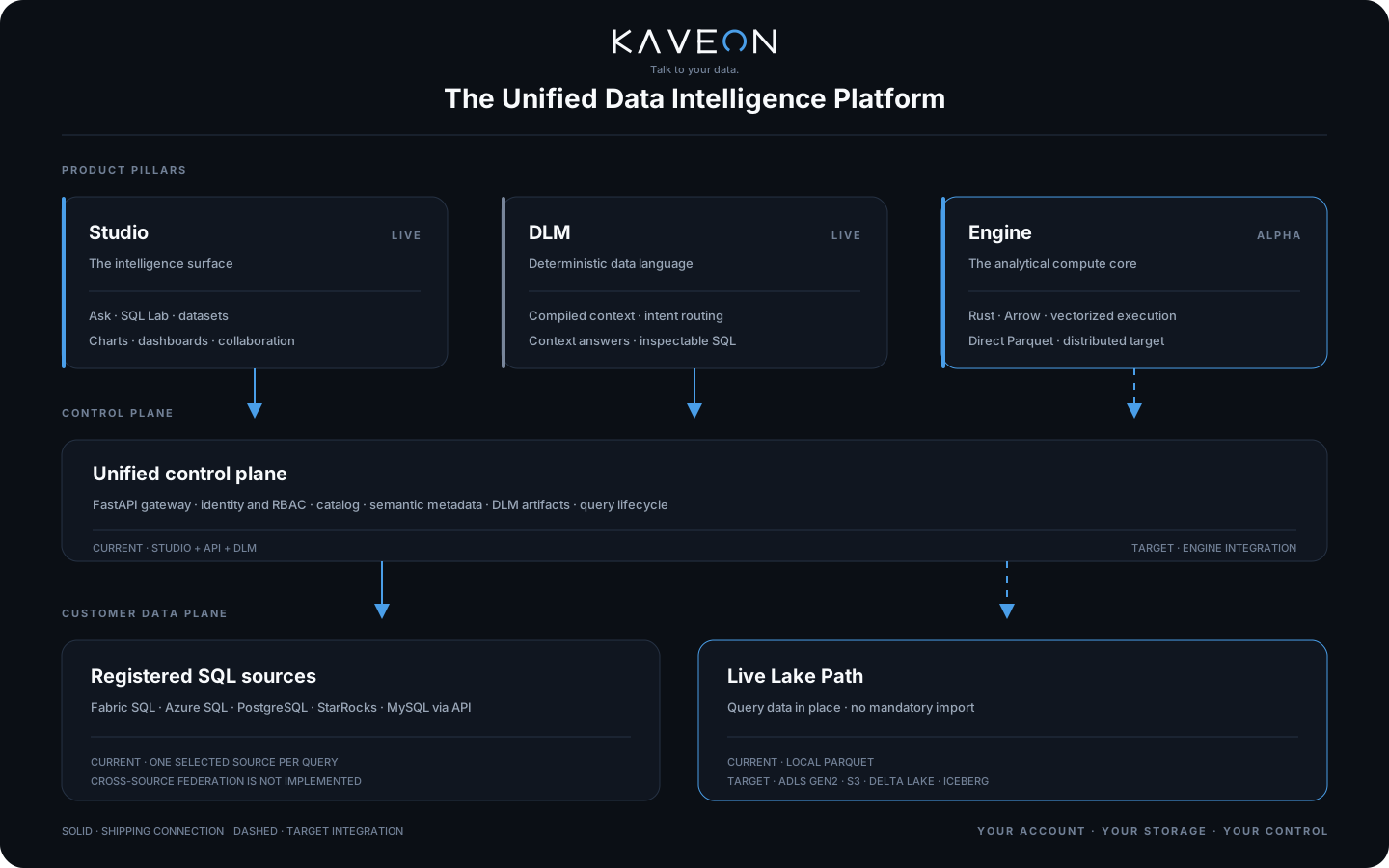
Runtime boundaries
| Component | Runtime | Maturity | Responsibility |
|---|---|---|---|
| Kaveon Studio | Next.js 15 · React 19 | Current | Ask, SQL Lab, semantic datasets, charts, dashboards, and administration. |
| Platform API + DLM | FastAPI · Python | Current | Authenticated application services, deterministic question resolution, and the statements it hands the Engine. |
| Kaveon Engine | Rust · Arrow · Delta on ADLS Gen2 | Alpha · qualified path | Durable catalog, optimized plans, distributed vectorized stages, Arrow IPC exchange, cube and sketch answers, and KaveonDB transactional records. |
The request path
Browser
  │ same-origin Auth.js session
  ▼
Kaveon Studio (Vercel, AKS, or VM)
  │ /api/kaveon/* proxy · authenticated identity headers
  ▼
Platform API + DLM (FastAPI)
  │
  ├─ Kaveon Engine ──► Delta tables in ADLS Gen2
  │                    cube cells and sketches, or a distributed scan
  └─ KaveonDB (kaveon.product.*) ──► the platform's own records
The browser does not send trusted identity headers directly. Studio derives identity from the server-side session and signs the proxy request with KAVEON_PROXY_SECRET. FastAPI can also validate configured provider-issued bearer tokens for direct API clients. Each query runs against one selected source; cross-source federation is not implemented.
How a statement executes
Remote CLI or Engine HTTP client
  ▼
Coordinator: durable catalog → SQL → optimizer → stage graph
  ▼
Versioned fragments → worker tasks → Arrow IPC exchanges
  ▼
local Parquet / Delta splits → root Arrow result
The Engine executes distributed scans, partial and final aggregates, Sort/TopN, and repartitioned or broadcast joins, with retry, cancellation, exchange cleanup and bounded Sort/TopN spill. A cube-shaped aggregate skips execution entirely and is answered from precomputed cells and HyperLogLog sketches; the record says which lane a statement took. Delta on ADLS Gen2 is in production use. S3, Iceberg, aggregate and join spill, and engine HTTP authentication with TLS remain target work.
Data and control planes
- Control plane: datasets, charts, dashboards, roles, history, DLM artifacts and configuration, held as transactional rows in
kaveon.product.*and written only through KaveonDB’s transaction boundary. - Lake data plane: Delta tables in ADLS Gen2, read by the Engine. This is where a query’s rows come from.
- Registered SQL data plane: a Fabric SQL, Azure SQL, PostgreSQL, MySQL or StarRocks source a tenant registers. One source per query; cross-source federation is not implemented.
Architectural invariants
- Identity is established at a verified trust boundary; raw client identity headers are never authoritative.
- Optimization may read extra data but must never omit qualifying rows.
- DLM acceleration complements Engine performance; it is not a substitute for a fast compute path.
- Performance claims must name the data, hardware, version, cache state, concurrency, and date.
- Current and target behaviour remain visibly distinct in product documentation.